Sunday, March 10, 2013

"The Art of Asking" from Former Lead Singer of the Dresden Dolls


As a last farewell for the quarter, I'd like to leave you all with this TED talk on couch surfing, crowd surfing, and intense eye contact.

As someone who's played music on a street corner to find out what makes people tick, who can only pay the co-creators of her business with a sense of engagement, who is relying on grants to get by, this hits home. For people like me who forget what it is they bring to the world... this is a good reminder.

Tuesday, March 5, 2013

In a follow-up to the last post, I got the chance to nomad around for about five months of last year (longer, depending on your definition) between a combination of couches and house-sitting gigs. It actually took me writing the last post to realize why this lifestyle seemed so familiar to me....

I take this moment to emphasize that urban nomadism, despite its connotations, is a perfectly valid state for valuable, productive members of society.

In the case of house-sitting it was always a mutually beneficial arrangement. (I cared for cats and houseplants, and in turn got to stay in swell places like this.)

It came to a close when the upheaval of moving every other week (and not knowing whether I would have a place the next) became too much between school and work. I wondered at the time, however, whether there wasn't some system out there that would take those barriers out of the equation.

There are in fact a few. It makes sense that when there's a value-creating opportunity, a business will arise to facilitate it. This is yet another model that has sprung up around our growing familiarity with impermanence.

Monday, March 4, 2013

At Home in a Cubby Hole

Last week we looked at printed homes and the displacement of the construction worker by the machine. This week I'd like to look at the displacement of the concept of a home by something else altogether.

Photo Credit: Urbanist
Urban nomadism, modern nomadism - these are terms referring to a lifestyle "where identity is becoming less rooted to a physical form and more to an intellectual, ideological and social basis". Whether vagabonds-by-choice or executives too busy to settle in any one city, urban nomads defy the importance of place in a civilized setting.

The modern nomad is "an otherwise 'normal' person living off social interactions, without a permanent home, but with adequate facilities to lead a fulfilling life." Many have paying jobs and would not consider themselves homeless in the conventional sense. As Yu Jie points out in her analysis, the movement is restricted in general to people between the ages of 18 and 30 with few ties. It's not everybody who feels compelled to pursue a nomadic existence.

But for those who do, how is the function of a home fulfilled without a fixed residence? Recent phenomena such as Couchsurfer and Airbnb have made the shift widely possible. "Living off social interactions", in the terms of value creation, means discovering untapped value in bridging the gap between people who have excess space, and people who need it. Not only is more gained by the receiving party than is lost by the donating party (value creation), there is the intangible value of interpersonal connection born spontaneously through this interaction.

As business-people, we ought to be aware of these untapped sources of value. It's what allowed Airbnb to become "one of Silicon Valley’s biggest startup success stories". If there are logistical barriers to overcome, business still has a primary role to play.


More than having a place to live, however, the ability to virtually store our most valuable possessions, from our cash to our work desk, has contributed to the movement. There is a growing sense that the essentials don't have to be carried with us. Urban nomads can leave behind their belongings without actually giving them up, confident that whatever they need, "the environment will provide".

This is the second opportunity of which businesses ought to be aware. People are taking more of their lives outside the home and the office. Coffee-shop culture has grown up around people's need to plug into their daily workspaces and access their social circles. Transit services now boast of wireless capabilities. It's practically become an expectation. How many other business models could spring up around the convenience of constant connectivity?

Finally, the implications for the construction industry will be interesting to explore.

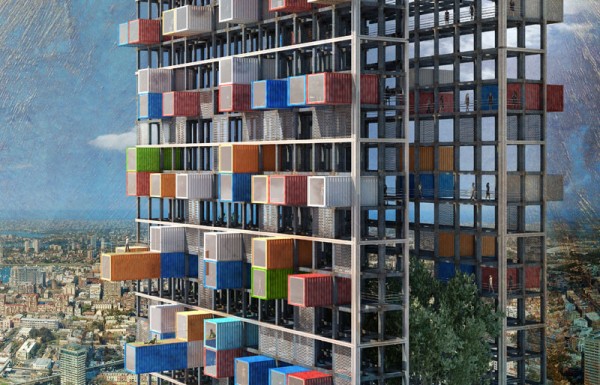
As architect Bruce Wrightsman says, "I was taught to understand the tenets of architecture as being built on longstanding ideals of firmness and permanence", rather than the ideals of "the new contemporary culture" where "lightness, efficiency and adaptability preside".

What new paradigms in construction will emerge as the concept of "home" shifts from the private to the public, the bounded to the unbounded?

Photo Credit: Luca D’Amico and Luca Tesio, Containers Skyscraper
P.S. I had a dream a long time ago that the world would look like this. I also dreamed a large meteor had hit the moon and left us in a global dust bowl. I hope not everything I dream comes true.

Tuesday, February 19, 2013

The Amorphous Future of Additive Manufacturing

Now, I think this is just cool:

Softkill Design's ProtoHouse

It's called 3D printing (or additive manufacturing) and it's changing the way architects view the limitations of the built environment.

This particular prototype is a scale model of a house printed using bone-growth algorithms, thereby maximizing the efficiency of material used while retaining structural strength.

I was introduced to the idea when I stumbled upon the 3D printer on my college campus. It looks something like a vending machine and produces plastic prototypes the size of Legos.

It wasn't long before I learned that Legos were just the beginning. Not only is the technology used to create bone transplants. Now they're developing printers that can construct entire buildings.

I'll admit I've been fairly skeptical. Wouldn't building and transporting a printer that size be just as time-consuming as laying concrete? And would the finished product resemble a climbing wall?

For the first instance - probably not, given that the first of these "small" printers is expected to be able to produce the equivalent of 12 two-story buildings in a year, or about four times faster than with conventional methods.

For the second - perhaps yes. The structures modeled so far certainly don't look like "marble" to me. However, I'm suspending judgement, especially because the technology's major proponent is hoping to use it to complete the Sagrada Familia, the remarkable Barcelonan cathedral imagined by architect Gaudi and only one-quarter finished before his death in 1926.

Photo Credit: Albert Sueba
Photo Credit: Ihsan Gercelman
In some senses this is the green architect's dream: eliminating carbon-emitting cement, preventing human error and drastically reducing waste. Yet on the other hand, it begs the question of what will become of construction jobs. In light of our recent conversation about the role of sustainable business in balancing efficiency versus employment (and the future of in-sourcing as brought up by Andrew Rodriguez), I wonder how this new phenomenon will provide for the 5-10% of industrialized nations' workforce employed as construction laborers.

Will it truly launch a revolution in construction, creating more outlets for skilled work in architecture, manufacture, and programming? Or will it further disempower the labor force? I believe if we continue to view human inputs as expendable, it will result in the latter, along with a slough of mindless construction. But if we can recognize that our machines are only as artistic as the intentions we feed them, we may yet live in a world with more beautiful, more equitable, and more sustainable architecture.

Monday, February 11, 2013

Walmart Data Center Remains a Mystery


We've been talking about market research, and in light of my recent thread on cloud storage, I couldn't resist posting on this top-secret Walmart data center, used (we may speculate) to process consumer data.

According to consumer activist Katherine Albrecht, one security company was asked by Walmart for ways to videotape customers paying for purchases, something she had thought to be "unbelievably outlandish because of the amount of data storage required."

However, at least back in 2004, Walmart had twice the storage capacity of the entire Internet.

Next time, smile as you buy!

Cloud or Slime Mold: The Future of Education


As I've been working to publish my company's first blog posts, I was struck by this prophetic diagram of four industries moving into the virtual cloud:


Now take a look at the top right quadrant:
I had just written about how most people have been "using the cloud for years without noticing" when I realized that's exactly what's been happening here at BGI, without my noticing.

Has anyone else found it odd that we're using Harvard Business School course material, that our lectures, quizzes & assignments float around in this place called Moodle, or that our online textbooks at Flatworld now include video?

In some sense, no kidding, this is an online program we're talking about. It shouldn't be such a surprise.

In another sense, just how much of this would have been possible less than five years ago? I think we've mentioned the term "disruptive technology" in lecture....

I remember the days before YouTube was a verb (when I still thought it was spelled U-Tube) and people used it mostly to post embarrassing or inane videos. Now the Khan Academy is a legitimate teaching tool (okay, so some of this is more present reality than actual prediction).

This examination of cloud-based business opportunities by Dion Hinchcliffe speaks to the radical growth of cloud in recent years.
To get a better sense of what's going on here, I visited another cloud computing phenomenon - Wikipedia - which tells me that "Cloud computing relies on sharing of resources to achieve coherence and economies of scale similar to a utility (like the electricity grid) over a network." There's a lot more I don't yet understand, but I'm fascinated by this idea of computing, as an extension of our brains, taking on an economy of scale.

And while I don't believe we're to the stage of uploading our entire psyches to a communal database:


We do exhibit some striking resemblance to slime mold which has been shown to leave itself memories in the form of external trails (true story: it takes 10 times longer for a slime mold to find food without access to its "collective database" of slime trails):

Photo Credit: Universitat Pompeu Fabra
www.medicaldaily.com/articles/12598/20121009/brainless-slime-molds-secrete-memories-solve-problems.htm
With some talk of the slime mold as the official BGI mascot, perhaps it's no coincidence that the education system upon which our graduate institute is built biomimics this enigmatic life-form. By outsourcing our knowledge from individuals, to classrooms, to entities beyond the walls of our institution, we're taking advantage of an economy of scale the slime mold discovered ages ago.

And we've been doing it practically without realizing it - how fascinating.

Monday, February 4, 2013

Mastering the Pivot

I've had the privilege of working with a startup company over the last few months - BuildersCloud, mentioned in an earlier post - and it's given me the chance to watch some of our Values and Value Creation learning in action.

I'd like to share a couple of examples:

First, the idea of an MVP: Minimum Viable Product. Going back to Steve Blank in "The Startup Owner's Manual" and Eric Ries in "Evangelizing for the Lean Startup", this is the idea of Just Getting Something Out There. I have to say as an introvert and recovering perfectionist, this concept is a little foreign to me, so I've had to set aside my biases.

The BuildersCloud interface has a total of... about four tools. At first I would have said, "What can you possibly do with four tools?" and pointed out other more button-pusher friendly interfaces such as PlanGrid's as possible examples.

It was after watching the videos above, I had something of an "aha" moment where I thought, "What if these were the only four tools contractors needed?" Then we'd be doing a perfect job with our MVP.

I'm still having a hard time convincing my scientist background how you'd actually go about testing the features people really want. Do you switch them up every week? Do you set up a control group and see which version gets the most hits? I realize that business isn't exactly like that. And at the same time, perhaps business is quite a lot like that. And that's the advantage in keeping features to a minimum.

Another point: Freemium pricing. This is the revenue plan under which BuildersCloud operates, designed to get a quorum of small contractors on board, while pressing those who can afford it - government agencies and utilities, for instance - to pay.

Now Eric Ries is pretty adamant about getting early customers to pay. As he tells it, the fact that certain visionaries were enlightened to buy even his "crappy" first iteration of IMVU told him that he had a winning product. But does this apply to a Freemium business model? And does it apply equally well to all products?

Instinctively, I would have thought a social networking service like IMVU ought to operate on a free trial basis to build initial momentum, but that's not what Ries did. So I wonder if BuildersCloud, being also a web-based, collaborative product, should be making as much of a deal about its free services.

Interestingly, the small contractors who the company originally targeted are fast being displaced by large corporate customers and agencies. So it seems people are willing to pay. And this brings us to the last item:

The Pivot: Working in the constant flux of a startup environment, I think I know exactly what Steve Blank is saying when he talks about "search" vs. "execution" mode. The change of target customer just mentioned - from small business to large construction company - has already wreaked havoc on our original branding scheme as we morph from cutesy to sleek.

Part of my work is drafting marketing materials, and I find myself turning pirouettes of my own as I seek to hone in on our marketing mission. And if I've learned my week's lessons, before I cobble anything too fancy together I'll remember to ask, "Is this MVP on track?"

Monday, January 28, 2013

Marketing in the Cloud Age

You may be familiar with “database marketing” – the way companies sort and prioritize customers so as to target their prospects most effectively.

In construction, this becomes particularly important as companies must continually search for new projects leads in order to stay in business.

Construction companies have a head start in that their customers are generally the first to initiate a request for services. This is what happens when a project goes up for bid. This means that contractors are saved the step of convincing prospects of the need for the service in the first place.

However, they face the challenge of convincing customers that they are the right company for the job. Once a project goes up for bid, they must be one of the first on the scene. And they must be able to perform that project with less cost and at as high a standard as their competitors. So it pays to have many prospects, and to have a way of quickly gauging your suitability for the job.

Traditionally, project lead gathering has been done through a combination of marketing methods. Companies may rely on word of mouth and previous interactions with customers to win them new bids. They may subscribe to project news bulletins like this one from Reed Construction Data. They may also promote themselves through paid directories such as The Blue Book. Yet many have not yet been able to benefit from database marketing.

Why is this? Database marketing has historically been reserved for larger companies with access to data warehouses. The larger the company, the greater the access to resources, the greater the likelihood of success.

Think of owning a personal library of 100 books. Now picture a public library with 10,000 books. Now multiply that by 10 libraries with an inter-library loan program. That is a 1000-times greater likelihood of finding the resource (or the prospect) you want.

Despite the Cloud being a nebulous and often-misunderstood tool, it will soon be changing the face of the market by opening this capability to smaller and larger companies alike.

In an effort to keep construction managers current, we’re breaking down the six main strategies of database marketing into their traditional and Cloud-enabled roles.

Segmentation
Sort customers by category; prioritize by potential
Search customer database by desired characteristics
New customer acquisition
Track acquisition; focus on high-ranking segments
Find customers not currently in your own database
Customer penetration
Compare total purchases to purchases per customer; increase purchases among existing customers
Receive real-time updates on customer needs; be first to reach out to fulfill those needs
Customer retention
Identify customer loss/inactivity; introduce loyalty-building strategies
Keep abreast of news on key customers; participate in social media conversations
Marketing intelligence
Gather qualitative information on customers
Customers add their own details to prepopulated profiles
Measuring results
Test effectiveness of programs & strategies
Track progress against competing companies

What does this imply for the construction industry?

For one, smaller businesses may receive more project leads as they are able to tap into the data-storage abilities of the Cloud.

There is the chance that marketing budgets may go down, at least in the area of data acquisition and storage, as this falls into the public domain. However, construction companies will find the need for new areas of expertise as they learn to promote themselves through these emerging channels.

Monday, January 14, 2013

A $20 Billion, 2000-Ton Problem

Today I'll be taking look at an industry that generates 160 million tons of waste annually[i], 70-80% of which is destined for landfill. You guessed it: the construction industry.

Some facts: The average new construction project yields 3.9 pounds of waste per square foot of building area, or 97.5 tons of waste for a 50,000-ft2 building.[ii] Every year in the US, approximately 5 billion square feet of new construction is built.[iii] That’s 9.75 million tons of waste from new construction each year.

Now you may be saying to yourself, “That's one industry that could benefit from an overhaul,” and this is probably true. But for now I’d like to look at one area of the industry that is often hidden from the casual observer. This is the way information is transmitted during the construction process.

Ever wonder how building plans get from an architect’s drawing board to the construction site? If you’re like me, you may have had a quaint idea of rolled-up blueprints being hand-delivered, unrolled, and voilĂ ! And it turns out you wouldn’t be far off.

Construction file-sharing still operates much as it did over the last century. Architectural plans are now drafted in CAD programs, yet being too large to email, are usually printed through a process called reprography (think “photography”) and delivered to the numerous parties involved. With the advent of “modern” technology, plans can now be sent from headquarters by CD, or an information-sharing platform known as an FTP (File Transfer Protocol).

Reprography is clunky, to say the least. It requires bulky machinery and heavy-weight paper that often cannot be recycled. Now, if you’re like me, you’re curious how many trees this disposes of and how much waste is produced. Well, I did my research (actually, someone had handily done the research for me) and the 37 million blueprints printed annually in the US alone come to 42,000 trees, or a line of felled trees stretching from New York to DC.[iv]

I calculated the waste that must result. At an estimated 1182 in2 of paper per blueprint (paper sizes range from 18x24” to 36x48”) and 187,000 in2 per 20-lb roll, this adds up to over 2000 tons of non-recyclable waste each year.

Now, I have some trouble imagining what 2000 tons looks like, so I went online for a visual aid, and came across this video of engineers moving a 2000-ton gantry crane:


Now, truly, in comparison to the 160 million tons generated annually by US construction, or even the 10 million tons generated by new construction, this figure is just a drop in the bucket. A 2000 ton drop, but a drop nonetheless.

Will evidence of this sort be enough to switch the industry to a less environmentally-costly method? I don’t believe so. To be fair, cost savings to the construction companies themselves should be demonstrated first.

To evaluate this, I will use a tool published by Osterwalder and Pigneur in their handbook “Business Model Generation”, called the Business Model Canvas. It sums up the activities engaged in, customers targeted and value generated by a company, all in one picture. A sample canvas for the construction industry might look like this:


Next, Osterwalder and Pigneur propose coupling their canvas with the Blue Ocean Strategy conceived by Kim and Mauborgne. This is a strategy which quite simply advocates reducing and eliminating cost items, while raising and creating new revenue streams.


Put in other terms, what can a company do to deliver the same (or a better) value proposition while incurring fewer costs and increasing revenue?

Right now, the largest delays occur before construction even begins, while project managers send blueprints to subcontractors in order to receive estimates. This process can take up to 1-2 months to complete. Add printing costs at around $30,000 per project, and you begin to see where some cost items might be reduced or eliminated.

Enter new technology. Software exists to take the struggle out of file-sharing. It’s just a matter of putting it into practice.

Andrey Nokhrin and Konstantin Novikov, co-founders of BuildersCloud, a startup I work with, are pioneers of such a technology. Working as a construction project manager for 5 years before starting his company, Nokhrin underwent all the hassles of communicating through outmoded technology. As he says, “$4 billion a year is spent in the US on paper plans alone, $10 billion a year on rework caused by outdated drawings, and $5-10 billion a year in wasted time. Altogether, it’s about a $20-25 billion/year problem.”

Based on his understanding of the biggest barriers in construction file-sharing, their software includes takeoff and estimating tools that allow subcontractors to compile quotes while skipping the printing step. It solves the file-size issue by storing projects in the virtual cloud, and gives contractors and clients an avenue of connection through a Yammer-type networking platform.

Will the industry adopt such technology, even if it promises savings on this scale? It depends: among bidders, who will clients pick? The company with the month-long delay and $30,000 in reprography printing costs? Or the one who has figured out how to eliminate these?

BuildersCloud is banking on the latter. Will software like theirs become the new industry standard? We'll soon see if their instincts are correct.


Construction documents range from 5 MB to several 100 MB[v], too large to be emailed. As it is, hundreds of files per project are printed, or sent by CD or FTP to subcontractors. However, this process can take weeks, and with file changes or corrections, months. With emerging software like this PlanViewer from BuildersCloud, blueprints can be viewed, corrections made and takeoff measurements performed instantaneously from a range of mobile devices.


[i] “Buildings and their Impact on the Environment:  A Statistical Summary.” US EPA
[ii] Monroe, Linda. “Diverting Construction Waste.” Buildings. March 1, 2008 <http://www.buildings.com/ArticleDetails/tabid/3321/ArticleID/5758/Default.aspx>.
[iii] “A Historic Opportunity.” 2030 Architecture. 2011 <http://architecture2030.org/the_solution/buildings_solution_how>.
[iv] Neal, Houston. “The End of Blueprints.” Software Advice. 10 Dec. 2009. <http://blog.softwareadvice.com/articles/construction/the-end-of-blueprints-1121009/>
[v] FTPforArchitects. <http://www.ftpforarchitects.com/>