Sunday, March 10, 2013

"The Art of Asking" from Former Lead Singer of the Dresden Dolls


As a last farewell for the quarter, I'd like to leave you all with this TED talk on couch surfing, crowd surfing, and intense eye contact.

As someone who's played music on a street corner to find out what makes people tick, who can only pay the co-creators of her business with a sense of engagement, who is relying on grants to get by, this hits home. For people like me who forget what it is they bring to the world... this is a good reminder.

Tuesday, March 5, 2013

In a follow-up to the last post, I got the chance to nomad around for about five months of last year (longer, depending on your definition) between a combination of couches and house-sitting gigs. It actually took me writing the last post to realize why this lifestyle seemed so familiar to me....

I take this moment to emphasize that urban nomadism, despite its connotations, is a perfectly valid state for valuable, productive members of society.

In the case of house-sitting it was always a mutually beneficial arrangement. (I cared for cats and houseplants, and in turn got to stay in swell places like this.)

It came to a close when the upheaval of moving every other week (and not knowing whether I would have a place the next) became too much between school and work. I wondered at the time, however, whether there wasn't some system out there that would take those barriers out of the equation.

There are in fact a few. It makes sense that when there's a value-creating opportunity, a business will arise to facilitate it. This is yet another model that has sprung up around our growing familiarity with impermanence.

Monday, March 4, 2013

At Home in a Cubby Hole

Last week we looked at printed homes and the displacement of the construction worker by the machine. This week I'd like to look at the displacement of the concept of a home by something else altogether.

Photo Credit: Urbanist
Urban nomadism, modern nomadism - these are terms referring to a lifestyle "where identity is becoming less rooted to a physical form and more to an intellectual, ideological and social basis". Whether vagabonds-by-choice or executives too busy to settle in any one city, urban nomads defy the importance of place in a civilized setting.

The modern nomad is "an otherwise 'normal' person living off social interactions, without a permanent home, but with adequate facilities to lead a fulfilling life." Many have paying jobs and would not consider themselves homeless in the conventional sense. As Yu Jie points out in her analysis, the movement is restricted in general to people between the ages of 18 and 30 with few ties. It's not everybody who feels compelled to pursue a nomadic existence.

But for those who do, how is the function of a home fulfilled without a fixed residence? Recent phenomena such as Couchsurfer and Airbnb have made the shift widely possible. "Living off social interactions", in the terms of value creation, means discovering untapped value in bridging the gap between people who have excess space, and people who need it. Not only is more gained by the receiving party than is lost by the donating party (value creation), there is the intangible value of interpersonal connection born spontaneously through this interaction.

As business-people, we ought to be aware of these untapped sources of value. It's what allowed Airbnb to become "one of Silicon Valley’s biggest startup success stories". If there are logistical barriers to overcome, business still has a primary role to play.


More than having a place to live, however, the ability to virtually store our most valuable possessions, from our cash to our work desk, has contributed to the movement. There is a growing sense that the essentials don't have to be carried with us. Urban nomads can leave behind their belongings without actually giving them up, confident that whatever they need, "the environment will provide".

This is the second opportunity of which businesses ought to be aware. People are taking more of their lives outside the home and the office. Coffee-shop culture has grown up around people's need to plug into their daily workspaces and access their social circles. Transit services now boast of wireless capabilities. It's practically become an expectation. How many other business models could spring up around the convenience of constant connectivity?

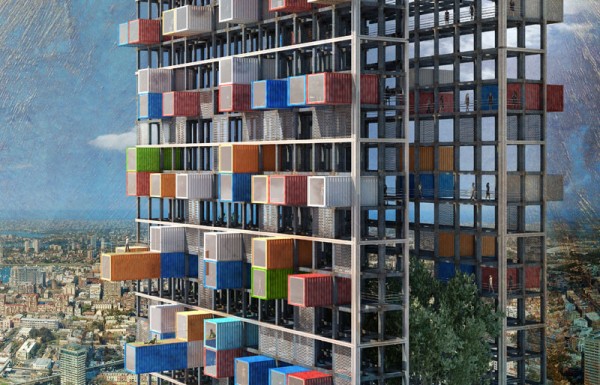
Finally, the implications for the construction industry will be interesting to explore.

As architect Bruce Wrightsman says, "I was taught to understand the tenets of architecture as being built on longstanding ideals of firmness and permanence", rather than the ideals of "the new contemporary culture" where "lightness, efficiency and adaptability preside".

What new paradigms in construction will emerge as the concept of "home" shifts from the private to the public, the bounded to the unbounded?

Photo Credit: Luca D’Amico and Luca Tesio, Containers Skyscraper
P.S. I had a dream a long time ago that the world would look like this. I also dreamed a large meteor had hit the moon and left us in a global dust bowl. I hope not everything I dream comes true.

Tuesday, February 19, 2013

The Amorphous Future of Additive Manufacturing

Now, I think this is just cool:

Softkill Design's ProtoHouse

It's called 3D printing (or additive manufacturing) and it's changing the way architects view the limitations of the built environment.

This particular prototype is a scale model of a house printed using bone-growth algorithms, thereby maximizing the efficiency of material used while retaining structural strength.

I was introduced to the idea when I stumbled upon the 3D printer on my college campus. It looks something like a vending machine and produces plastic prototypes the size of Legos.

It wasn't long before I learned that Legos were just the beginning. Not only is the technology used to create bone transplants. Now they're developing printers that can construct entire buildings.

I'll admit I've been fairly skeptical. Wouldn't building and transporting a printer that size be just as time-consuming as laying concrete? And would the finished product resemble a climbing wall?

For the first instance - probably not, given that the first of these "small" printers is expected to be able to produce the equivalent of 12 two-story buildings in a year, or about four times faster than with conventional methods.

For the second - perhaps yes. The structures modeled so far certainly don't look like "marble" to me. However, I'm suspending judgement, especially because the technology's major proponent is hoping to use it to complete the Sagrada Familia, the remarkable Barcelonan cathedral imagined by architect Gaudi and only one-quarter finished before his death in 1926.

Photo Credit: Albert Sueba
Photo Credit: Ihsan Gercelman
In some senses this is the green architect's dream: eliminating carbon-emitting cement, preventing human error and drastically reducing waste. Yet on the other hand, it begs the question of what will become of construction jobs. In light of our recent conversation about the role of sustainable business in balancing efficiency versus employment (and the future of in-sourcing as brought up by Andrew Rodriguez), I wonder how this new phenomenon will provide for the 5-10% of industrialized nations' workforce employed as construction laborers.

Will it truly launch a revolution in construction, creating more outlets for skilled work in architecture, manufacture, and programming? Or will it further disempower the labor force? I believe if we continue to view human inputs as expendable, it will result in the latter, along with a slough of mindless construction. But if we can recognize that our machines are only as artistic as the intentions we feed them, we may yet live in a world with more beautiful, more equitable, and more sustainable architecture.

Monday, February 11, 2013

Walmart Data Center Remains a Mystery


We've been talking about market research, and in light of my recent thread on cloud storage, I couldn't resist posting on this top-secret Walmart data center, used (we may speculate) to process consumer data.

According to consumer activist Katherine Albrecht, one security company was asked by Walmart for ways to videotape customers paying for purchases, something she had thought to be "unbelievably outlandish because of the amount of data storage required."

However, at least back in 2004, Walmart had twice the storage capacity of the entire Internet.

Next time, smile as you buy!

Cloud or Slime Mold: The Future of Education


As I've been working to publish my company's first blog posts, I was struck by this prophetic diagram of four industries moving into the virtual cloud:


Now take a look at the top right quadrant:
I had just written about how most people have been "using the cloud for years without noticing" when I realized that's exactly what's been happening here at BGI, without my noticing.

Has anyone else found it odd that we're using Harvard Business School course material, that our lectures, quizzes & assignments float around in this place called Moodle, or that our online textbooks at Flatworld now include video?

In some sense, no kidding, this is an online program we're talking about. It shouldn't be such a surprise.

In another sense, just how much of this would have been possible less than five years ago? I think we've mentioned the term "disruptive technology" in lecture....

I remember the days before YouTube was a verb (when I still thought it was spelled U-Tube) and people used it mostly to post embarrassing or inane videos. Now the Khan Academy is a legitimate teaching tool (okay, so some of this is more present reality than actual prediction).

This examination of cloud-based business opportunities by Dion Hinchcliffe speaks to the radical growth of cloud in recent years.
To get a better sense of what's going on here, I visited another cloud computing phenomenon - Wikipedia - which tells me that "Cloud computing relies on sharing of resources to achieve coherence and economies of scale similar to a utility (like the electricity grid) over a network." There's a lot more I don't yet understand, but I'm fascinated by this idea of computing, as an extension of our brains, taking on an economy of scale.

And while I don't believe we're to the stage of uploading our entire psyches to a communal database:


We do exhibit some striking resemblance to slime mold which has been shown to leave itself memories in the form of external trails (true story: it takes 10 times longer for a slime mold to find food without access to its "collective database" of slime trails):

Photo Credit: Universitat Pompeu Fabra
www.medicaldaily.com/articles/12598/20121009/brainless-slime-molds-secrete-memories-solve-problems.htm
With some talk of the slime mold as the official BGI mascot, perhaps it's no coincidence that the education system upon which our graduate institute is built biomimics this enigmatic life-form. By outsourcing our knowledge from individuals, to classrooms, to entities beyond the walls of our institution, we're taking advantage of an economy of scale the slime mold discovered ages ago.

And we've been doing it practically without realizing it - how fascinating.

Monday, February 4, 2013

Mastering the Pivot

I've had the privilege of working with a startup company over the last few months - BuildersCloud, mentioned in an earlier post - and it's given me the chance to watch some of our Values and Value Creation learning in action.

I'd like to share a couple of examples:

First, the idea of an MVP: Minimum Viable Product. Going back to Steve Blank in "The Startup Owner's Manual" and Eric Ries in "Evangelizing for the Lean Startup", this is the idea of Just Getting Something Out There. I have to say as an introvert and recovering perfectionist, this concept is a little foreign to me, so I've had to set aside my biases.

The BuildersCloud interface has a total of... about four tools. At first I would have said, "What can you possibly do with four tools?" and pointed out other more button-pusher friendly interfaces such as PlanGrid's as possible examples.

It was after watching the videos above, I had something of an "aha" moment where I thought, "What if these were the only four tools contractors needed?" Then we'd be doing a perfect job with our MVP.

I'm still having a hard time convincing my scientist background how you'd actually go about testing the features people really want. Do you switch them up every week? Do you set up a control group and see which version gets the most hits? I realize that business isn't exactly like that. And at the same time, perhaps business is quite a lot like that. And that's the advantage in keeping features to a minimum.

Another point: Freemium pricing. This is the revenue plan under which BuildersCloud operates, designed to get a quorum of small contractors on board, while pressing those who can afford it - government agencies and utilities, for instance - to pay.

Now Eric Ries is pretty adamant about getting early customers to pay. As he tells it, the fact that certain visionaries were enlightened to buy even his "crappy" first iteration of IMVU told him that he had a winning product. But does this apply to a Freemium business model? And does it apply equally well to all products?

Instinctively, I would have thought a social networking service like IMVU ought to operate on a free trial basis to build initial momentum, but that's not what Ries did. So I wonder if BuildersCloud, being also a web-based, collaborative product, should be making as much of a deal about its free services.

Interestingly, the small contractors who the company originally targeted are fast being displaced by large corporate customers and agencies. So it seems people are willing to pay. And this brings us to the last item:

The Pivot: Working in the constant flux of a startup environment, I think I know exactly what Steve Blank is saying when he talks about "search" vs. "execution" mode. The change of target customer just mentioned - from small business to large construction company - has already wreaked havoc on our original branding scheme as we morph from cutesy to sleek.

Part of my work is drafting marketing materials, and I find myself turning pirouettes of my own as I seek to hone in on our marketing mission. And if I've learned my week's lessons, before I cobble anything too fancy together I'll remember to ask, "Is this MVP on track?"