Last week we looked at printed homes and the displacement of the construction worker by the machine. This week I'd like to look at the displacement of the concept of a home by something else altogether.
Urban nomadism, modern nomadism - these are terms referring to a lifestyle "where identity is becoming less rooted to a physical form and more to an intellectual, ideological and social basis". Whether vagabonds-by-choice or executives too busy to settle in any one city, urban nomads defy the importance of place in a civilized setting.
The modern nomad is "an otherwise 'normal' person living off social interactions, without a permanent home, but with adequate facilities to lead a fulfilling life." Many have paying jobs and would not consider themselves homeless in the conventional sense. As Yu Jie points out in her analysis, the movement is restricted in general to people between the ages of 18 and 30 with few ties. It's not everybody who feels compelled to pursue a nomadic existence.
But for those who do, how is the function of a home fulfilled without a fixed residence? Recent phenomena such as Couchsurfer and Airbnb have made the shift widely possible. "Living off social interactions", in the terms of value creation, means discovering untapped value in bridging the gap between people who have excess space, and people who need it. Not only is more gained by the receiving party than is lost by the donating party (value creation), there is the intangible value of interpersonal connection born spontaneously through this interaction.
As business-people, we ought to be aware of these untapped sources of value. It's what allowed Airbnb to become "one of Silicon Valley’s biggest startup success stories". If there are logistical barriers to overcome, business still has a primary role to play.
More than having a place to live, however, the ability to virtually store our most valuable possessions, from our cash to our work desk, has contributed to the movement. There is a growing sense that the essentials don't have to be carried with us. Urban nomads can leave behind their belongings without actually giving them up, confident that whatever they need, "the environment will provide".
This is the second opportunity of which businesses ought to be aware. People are taking more of their lives outside the home and the office. Coffee-shop culture has grown up around people's need to plug into their daily workspaces and access their social circles. Transit services now boast of wireless capabilities. It's practically become an expectation. How many other business models could spring up around the convenience of constant connectivity?
Finally, the implications for the construction industry will be interesting to explore.
As architect Bruce Wrightsman says, "I was taught to understand the tenets of architecture as being built on longstanding ideals of firmness and permanence", rather than the ideals of "the new contemporary culture" where "lightness, efficiency and adaptability preside".
What new paradigms in construction will emerge as the concept of "home" shifts from the private to the public, the bounded to the unbounded?
P.S. I had a dream a long time ago that the world would look like this. I also dreamed a large meteor had hit the moon and left us in a global dust bowl. I hope not everything I dream comes true.
 |
| Photo Credit: Urbanist |
The modern nomad is "an otherwise 'normal' person living off social interactions, without a permanent home, but with adequate facilities to lead a fulfilling life." Many have paying jobs and would not consider themselves homeless in the conventional sense. As Yu Jie points out in her analysis, the movement is restricted in general to people between the ages of 18 and 30 with few ties. It's not everybody who feels compelled to pursue a nomadic existence.
But for those who do, how is the function of a home fulfilled without a fixed residence? Recent phenomena such as Couchsurfer and Airbnb have made the shift widely possible. "Living off social interactions", in the terms of value creation, means discovering untapped value in bridging the gap between people who have excess space, and people who need it. Not only is more gained by the receiving party than is lost by the donating party (value creation), there is the intangible value of interpersonal connection born spontaneously through this interaction.
As business-people, we ought to be aware of these untapped sources of value. It's what allowed Airbnb to become "one of Silicon Valley’s biggest startup success stories". If there are logistical barriers to overcome, business still has a primary role to play.
More than having a place to live, however, the ability to virtually store our most valuable possessions, from our cash to our work desk, has contributed to the movement. There is a growing sense that the essentials don't have to be carried with us. Urban nomads can leave behind their belongings without actually giving them up, confident that whatever they need, "the environment will provide".
This is the second opportunity of which businesses ought to be aware. People are taking more of their lives outside the home and the office. Coffee-shop culture has grown up around people's need to plug into their daily workspaces and access their social circles. Transit services now boast of wireless capabilities. It's practically become an expectation. How many other business models could spring up around the convenience of constant connectivity?
Finally, the implications for the construction industry will be interesting to explore.
As architect Bruce Wrightsman says, "I was taught to understand the tenets of architecture as being built on longstanding ideals of firmness and permanence", rather than the ideals of "the new contemporary culture" where "lightness, efficiency and adaptability preside".
What new paradigms in construction will emerge as the concept of "home" shifts from the private to the public, the bounded to the unbounded?
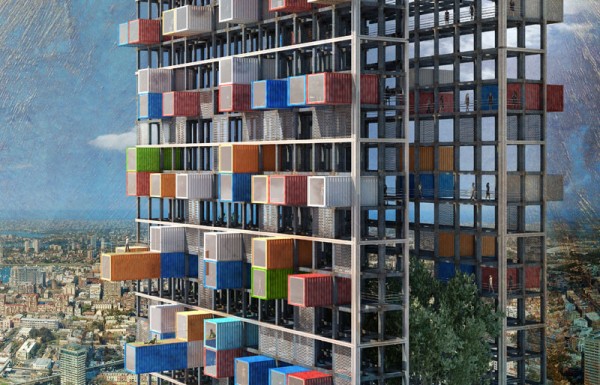 |
| Photo Credit: Luca D’Amico and Luca Tesio, Containers Skyscraper |

No comments:
Post a Comment